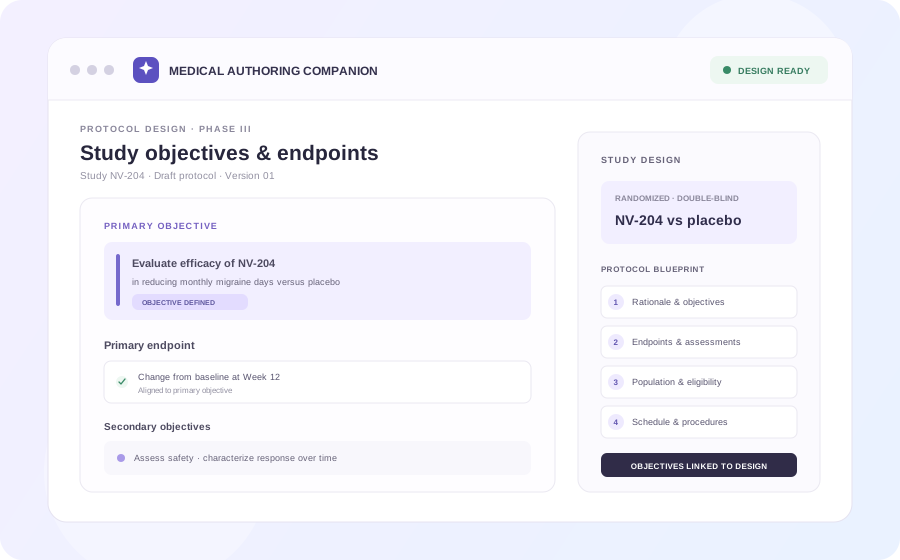
Design the study
Shape trial structure, methodology, objectives, endpoints, phases, arms, and randomization strategy before drafting begins.

Specialized AI agents help clinical teams create compliant, submission-ready trial protocols in hours instead of weeks—from initial synopsis through expert review.
AI AGENTS TRUSTED BY LIFE SCIENCES ORGANIZATIONS





Specialized Protocol AI Agents support the full authoring workflow—from trial design and patient-burden analysis to compliant drafting and final quality review.
Shape trial structure, methodology, objectives, endpoints, phases, arms, and randomization strategy before drafting begins.
Evaluate visit schedules, assessment frequency, and procedural complexity to improve patient and site feasibility, retention, and enrollment.
Check inclusion and exclusion criteria against real-world population data, identify enrollment challenges, and support diverse, representative trials.
Align drafts to ICH M11 templates, sponsor-specific guidelines, and trusted regulatory sources from the start.
Turn a brief synopsis and reference documents into a structured protocol, drawing on study and drug metadata, historical protocols, and knowledge bases.
Keep medical writers and reviewers in control with collaboration, version tracking, quality checks, traceability, and submission-ready document export.
Clinical trial protocols define a study’s rationale, objectives, design, methodology, endpoints, patient populations, and statistical considerations. Traditional authoring takes weeks of manual drafting, regulatory cross-referencing, and review across medical, regulatory, and biostatistics teams.
Medical Authoring Companion coordinates specialized AI agents to generate structured drafts grounded in study-level and drug-level metadata, historical protocols, and trusted regulatory knowledge. Source-linked content, compliance checks, and quality control help teams move efficiently while keeping expert reviewers in control.
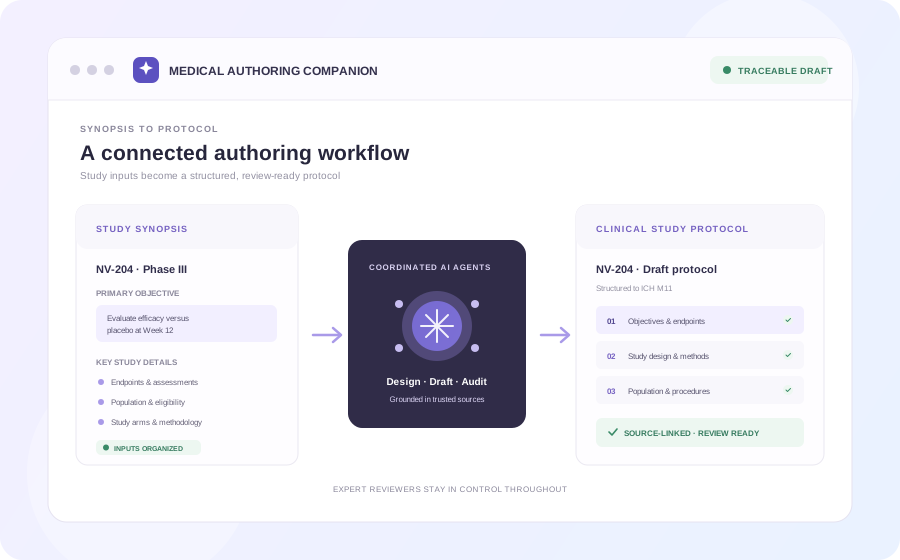
Learn how coordinated AI agents support compliant, patient-aware clinical trial protocols.
Medical Authoring Companion uses specialized agents to transform an initial synopsis and reference materials into a structured clinical trial protocol. Agents support protocol design, patient and site burden analysis, study population evaluation, drafting, and compliance auditing—streamlining work from initial study inputs to a submission-ready document.
Rather than generating text in isolation, the workflow integrates study and drug metadata with historical protocols and trusted regulatory knowledge. Sections are produced with source traceability to support quality assurance and review.
Protocol Design helps define study structure, methodology, objectives, endpoints, trial phases, arms, and randomization strategies before document drafting begins.
Protocol Burden evaluates visit schedules, assessment frequency, and procedural complexity, recommending streamlined designs that improve patient retention and site feasibility.
Protocol Study Population checks inclusion and exclusion criteria against real-world population data, flags enrollment challenges, and helps teams improve diversity and representativeness.
Protocol Auditor benchmarks protocol sections against ICH M11, sponsor templates, and regulatory requirements to identify compliance gaps before submission. QC Validator and Compliance Specialist agents provide additional consistency and quality checks.
Teams provide a brief protocol summary and any reference documents. AI agents extract details such as therapeutic area, trial phase, drug mechanism of action, patient population, and endpoints. The Protocol Design agent then creates a structured draft aligned with ICH M11, using the Narrativa Knowledge Graph, historical protocols, and trusted regulatory sources.
Population and burden agents review the proposed design in parallel. The platform integrates relevant information into coherent protocol sections and links generated content back to its sources.
The Protocol Auditor checks alignment with ICH M11 templates, sponsor-specific guidelines, and applicable regulatory requirements. The agents use domain knowledge and historical trial data to generate contextually relevant content, while source links and quality-control checks help reviewers verify the draft and catch inconsistencies early.
Medical writers and reviewers retain oversight throughout the process, with version tracking and real-time collaboration supporting refinement and final validation.
The Protocol Burden agent evaluates schedules of visits, how often assessments occur, and the complexity of trial procedures. It recommends ways to streamline the design for patients and sites. The Protocol Study Population agent evaluates eligibility criteria against real-world population data, surfacing potential enrollment barriers and opportunities to broaden eligible patient pools.
These checks help teams consider feasibility and representativeness earlier, with the goal of supporting retention and accelerating enrollment.
Medical writers and cross-functional reviewers collaborate on the generated draft with version tracking, refining protocol content within existing document workflows. Quality and compliance agents help maintain consistency during review; the Protocol Auditor checks the finalized document for regulatory gaps. Source traceability supports quality assurance, and the completed protocol can be exported as a submission-ready document.
By reducing repetitive writing, formatting, and cross-referencing work, teams can shorten drafting and review cycles and focus more time on scientific decisions. Protocol automation also fits into a broader regulatory workflow spanning study design, clinical study reports, and submission documentation.
Automating repetitive drafting, formatting, and compliance checks can reduce manual workload and associated costs, shorten review cycles, improve consistency, and help teams accelerate study initiation and time-to-first-patient. Narrativa’s source content cites potential manual-workload reductions of up to 60%. The aim is to free medical writing teams to focus on higher-value research and development activities while maintaining quality and regulatory oversight.
A clinical protocol is the starting blueprint for a study, documenting its rationale, objectives, design, methodology, endpoints, statistical considerations, and organization. Medical Authoring Companion supports the document lifecycle from this initial design through the clinical study report that documents trial results, creating a connected AI-supported path toward regulatory submission.
The broader workflow can connect protocol development with patient recruitment, site selection, data management, clinical study reports, and regulatory documentation.
Research published by the Georgia Institute of Technology on “Intelligent Clinical Trial Design Support using Generative AI” describes how large language models with comprehensive drug and study metadata can generate protocol sections that are accurate, contextually rich, and coherent. Narrativa builds on these capabilities with agent orchestration, traceability, compliance checks, and domain-specific customization for production protocol-authoring workflows.